Blog
Pokémon Stats Explained: Base Stats, IVs, EVs and Natures
· 5 min read
Pokémon stats can differ even between two Pokémon of the same species at the same level. One Garchomp might outspeed an opponent while another of the same level gets hit first. The difference comes down to four things: base stats, IVs, EVs, and natures. Once you understand how they work together, you can see why some Pokémon perform better than others and how to train yours to its full potential.
The Six Stats
Every Pokémon has six stats:
- HP: how much damage it can take before fainting
- Attack: the power of its physical moves
- Defense: how well it resists physical moves
- Special Attack: the power of its special moves
- Special Defense: how well it resists special moves
- Speed: which Pokémon moves first each turn
Whether a move is physical or special depends on the move itself. Earthquake is physical, so it uses the attacker's Attack against the target's Defense. Flamethrower is special, so it uses Special Attack against Special Defense. A Pokémon with high Attack but low Special Attack should run mostly physical moves, even if its best-known moves are special.
Base Stats: What Each Species Is Built For
Base stats are fixed values for each species. Every Garchomp has the same base stats, and they define the Pokémon's natural strengths. Adding all six together gives the base stat total (BST), a rough measure of overall power.
The distribution matters more than the total. A few extreme examples show how differently species can be built:
- Blissey has a base HP of 255, the highest in the game, but very low Defense.
- Shuckle has base Defense and Special Defense of 230 each, but its offensive stats are among the lowest of any Pokémon.
- Regieleki has a base Speed of 200, the fastest of any Pokémon.
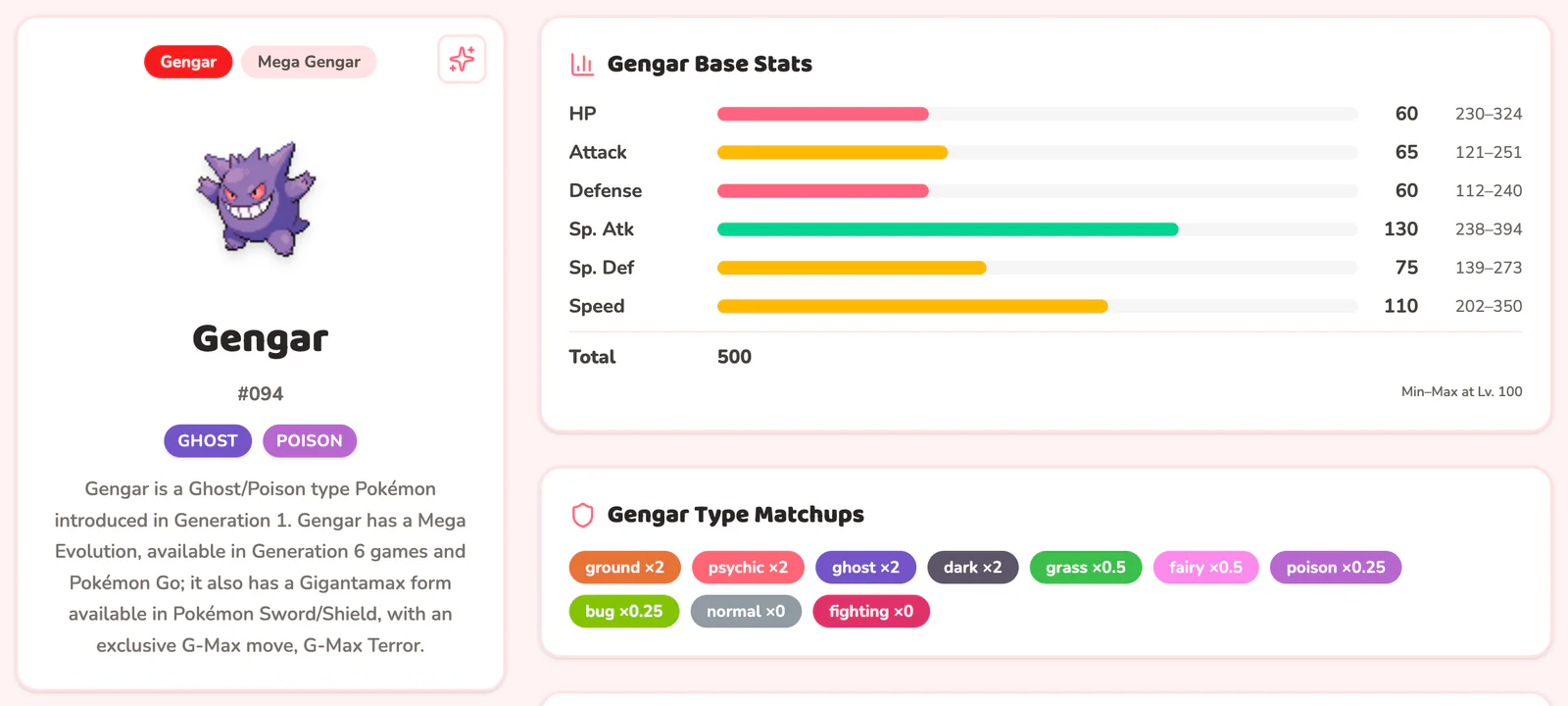
When you check a Pokémon's page in the database, its base stat spread tells you what role it is suited for: a fast attacker, a slow tank, a mixed attacker, and so on.
IVs: A Pokémon's Genetics
Individual Values (IVs) are hidden values from 0 to 31, set for each stat when a Pokémon is caught, hatched, or received. Think of them as genetics. Two Pokémon of the same species can differ by up to 31 points in a stat at level 100 because of IVs alone.
A Pokémon with 31 in a stat is often called "perfect" in that stat. For competitive play, most players want 31 in every stat they use. There are exceptions, though. A Pokémon that relies only on special moves may prefer 0 Attack IVs, because some moves, like Foul Play, and confusion damage use the Pokémon's own Attack stat against it.
Recent games make IVs easier to manage. The in-game "Judge" feature shows how good a Pokémon's IVs are, and Hyper Training with Bottle Caps lets you max out a high-level Pokémon's stats without breeding for perfect IVs.
EVs: The Results of Training
Effort Values (EVs) are points a Pokémon earns through training, mostly by defeating other Pokémon. Each species gives specific EVs when defeated. For example, defeating a fast Pokémon usually gives Speed EVs.
The rules are:
- A Pokémon can have a maximum of 510 EVs in total.
- A single stat can hold a maximum of 252 EVs.
- At level 100, every 4 EVs adds 1 stat point, so 252 EVs adds 63 points to a stat.
Because of the 510 limit, you can max out two stats and have a few points left over. The most common competitive spread puts 252 EVs into the Pokémon's main attacking stat, 252 into Speed, and the remaining 4 into HP or a defensive stat. Bulkier Pokémon often invest in HP and one defensive stat instead.
You can also adjust EVs with items. Vitamins like Protein and Carbos add EVs to specific stats. Certain Berries lower them, which is useful if you want to reset a stat you trained by accident.
Natures: The Final 10%
Every Pokémon has one of 25 natures. Twenty of them raise one stat by 10% and lower another by 10%. The other five, like Hardy and Serious, have no effect. HP is never changed by a nature.
The most popular natures for competitive play are:
- Adamant: raises Attack, lowers Special Attack. Used on physical attackers.
- Jolly: raises Speed, lowers Special Attack. Used on fast physical attackers.
- Modest: raises Special Attack, lowers Attack. Used on special attackers.
- Timid: raises Speed, lowers Attack. Used on fast special attackers.
- Bold: raises Defense, lowers Attack. Used on physical walls.
- Calm: raises Special Defense, lowers Attack. Used on special walls.
The trick is to lower a stat your Pokémon doesn't use. A special attacker doesn't need Attack, so a Modest or Timid nature costs it nothing.
Since Pokémon Sword and Shield, Mints let you change the effect of a Pokémon's nature without catching a new one.
Putting It Together: A Garchomp Speed Example
Here is how the numbers add up for Garchomp's Speed at level 100. Its base Speed is 102.
- With 31 IVs and 252 EVs in Speed, Garchomp reaches 303 Speed with a neutral nature.
- With a Jolly nature, that rises to 333.
At level 50, the level used in most official competitive formats, the same max Speed Garchomp has 169.
Those 30 points from the nature alone are often the difference between moving first and getting knocked out. This is why competitive players care so much about getting all four factors right.
Why Speed Gets So Much Attention
Speed decides turn order, and moving first often decides the battle. A Pokémon that outspeeds and knocks out its opponent never takes a hit. Because of this, players often calculate Speed down to the exact point to outspeed a specific threat.
There are a few ways to get around the Speed stat:
- Priority moves like Quick Attack and Extreme Speed go first regardless of Speed.
- Trick Room reverses turn order for five turns, so the slowest Pokémon move first.
- Stat-boosting moves like Dragon Dance raise Speed during battle. Each boost stacks, up to a maximum of four times the original stat.
If two Pokémon have exactly the same Speed, the game picks randomly who moves first.
Final Thoughts
Base stats tell you what a Pokémon is built for. IVs, EVs, and natures decide how close it gets to its full potential. You don't need perfect stats to finish a story playthrough. But if you want to compete, or just want your favorite Pokémon to be as strong as possible, these four factors are where the difference is made.
Check any Pokémon's base stats on Pokemondatabase.com to plan the right EV spread and nature before you start training.
Related Pokémon Guides
- Pokémon Type Chart Guide: how type matchups, STAB and immunities work
- Pokémon Held Items Guide: the best held items and when to use them
- Pokémon Status Conditions Guide: what burn, paralysis, poison, sleep and freeze do
- Pokémon Weather and Terrain Guide: how weather and terrain change a battle
- Pokémon Abilities Guide: the best abilities and how they shape matchups
- How to Build a Competitive Pokémon Team: a step-by-step team building process
Looking something up? Browse the full Pokémon pages, type pages, move pages, item pages, ability pages and location pages on Pokemondatabase.com.
- base stats
- IVs
- EVs
- natures
- competitive