Blog
Pokémon Type Chart Explained: How to Use Type Matchups
· 5 min read
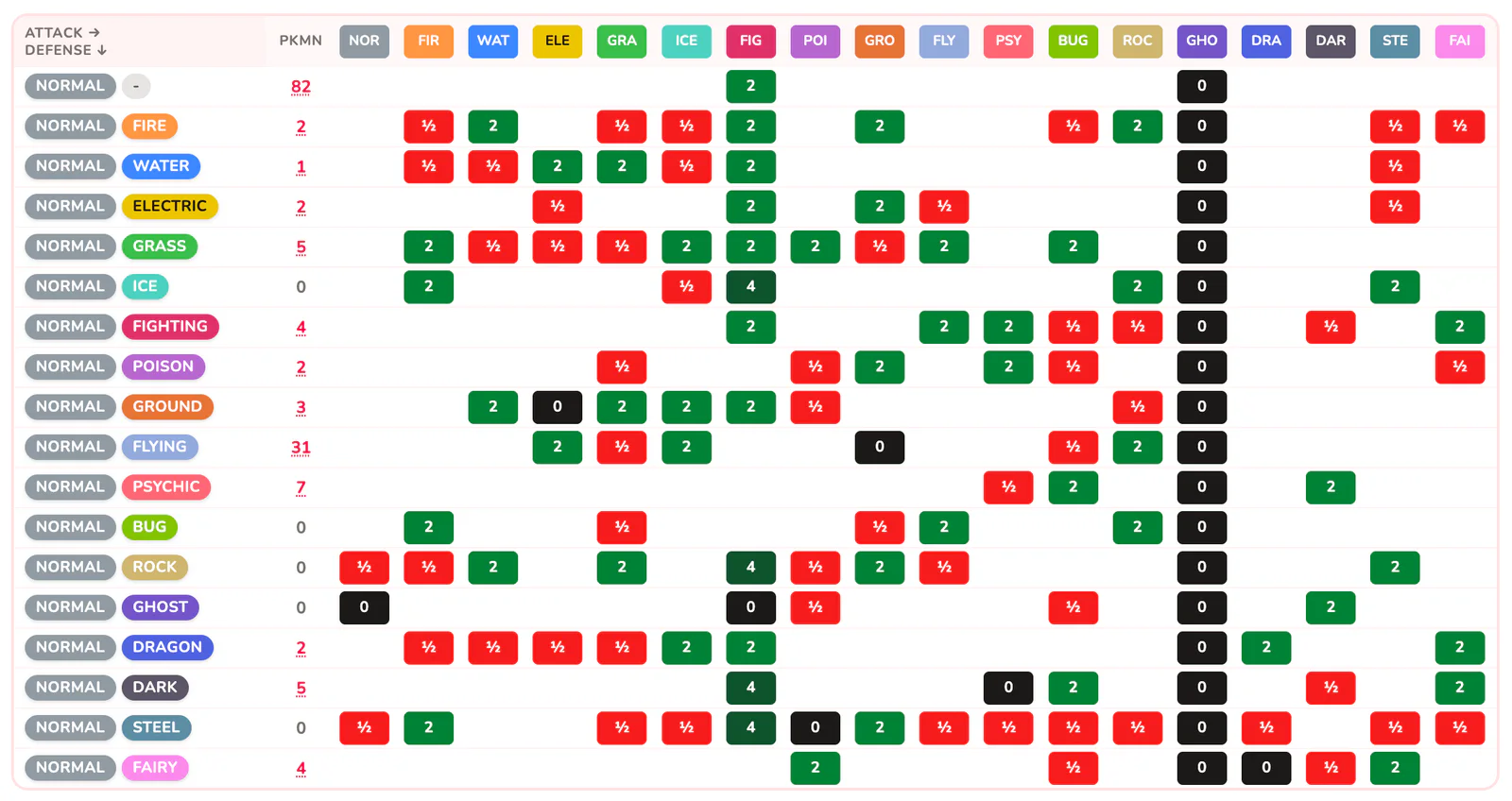
Every Pokémon player has stared at the Pokémon type chart at some point. Eighteen types, hundreds of interactions, and a grid of colored squares that is hard to memorize. But knowing that Water beats Fire is only the start. The players who win consistently understand why matchups work the way they do and how to use that on both offense and defense.
This guide covers the mechanics behind type effectiveness, the matchups that trip people up most often, and how to use type knowledge when building a team.
How Type Effectiveness Works
Every attacking move has a type, and every Pokémon has one or two types. When a move hits, the game compares the move's type with the defender's types and applies a multiplier:
- Super effective: 2× damage
- Neutral: 1× damage
- Not very effective: 0.5× damage
- No effect: 0× damage (an immunity)
For dual-type Pokémon, the multipliers stack. If a move is super effective against both types, it does 4× damage. If both types resist it, it does only 0.25×. If one type is weak and the other resists, they cancel out to neutral.
4× Weaknesses
The 4× weaknesses are where battles are often decided. A few well-known examples:
- Gyarados (Water/Flying) takes 4× damage from Electric moves.
- Garchomp (Dragon/Ground) takes 4× damage from Ice moves.
- Scizor (Bug/Steel) takes 4× damage from Fire moves, its only weakness.
A Pokémon with a 4× weakness is not necessarily bad. Scizor has just one weakness and is otherwise very hard to damage. You just need to know that one matchup is a guaranteed problem and plan around it.
Same-Type Attack Bonus (STAB)
Type matters on offense too. When a Pokémon uses a move that matches one of its own types, it gets a Same-Type Attack Bonus, which multiplies damage by 1.5×. This is why a Fire-type using Flamethrower hits harder than a Water-type using the same move.
STAB combines with type effectiveness. A STAB move that is super effective does 3× damage compared with a neutral, non-STAB hit. This is the main reason Pokémon usually run attacks of their own type.
The Immunities You Need to Memorize
Immunities are the most important part of the chart to know by heart, because a move that does zero damage wastes your entire turn. These are the type-based immunities:
- Normal moves have no effect on Ghost.
- Fighting moves have no effect on Ghost.
- Ghost moves have no effect on Normal.
- Electric moves have no effect on Ground.
- Ground moves have no effect on Flying.
- Psychic moves have no effect on Dark.
- Poison moves have no effect on Steel.
- Dragon moves have no effect on Fairy.
Some abilities also grant immunities. The best-known is Levitate, which makes a Pokémon immune to Ground moves regardless of its type. Always check a Pokémon's possible abilities before assuming a matchup.
The Best Defensive Types
Some types are far better at taking hits than others.
Steel: The Strongest Defensive Type
Steel is the strongest defensive type in the game. It resists ten types: Normal, Grass, Ice, Flying, Psychic, Bug, Rock, Dragon, Steel, and Fairy. It is also immune to Poison. Its only weaknesses are Fire, Fighting, and Ground.
Fairy: Built to Balance Dragons
Fairy was added in Generation 6, largely to balance Dragon types, which had very few weaknesses until then. Fairy is immune to Dragon and resists Fighting, Bug, and Dark.
Ice: The Weakest Defensive Type
At the other end, Ice is widely considered the weakest defensive type. It resists only itself and is weak to Fire, Fighting, Rock, and Steel, all common attacking types. Ice is much better on offense, which is why many teams carry an Ice move without carrying an Ice-type Pokémon.
Typings That Work Well Together
The right type combination can cover one type's weaknesses with the other's strengths. A few standout examples:
- Water/Ground (like Swampert): Ground removes Water's weakness to Electric, leaving Grass as its only weakness.
- Steel/Fairy (like Klefki): Steel covers Fairy's weaknesses to Poison, and Fairy adds the Dragon immunity. The result is only two weaknesses: Fire and Ground.
- Ghost/Dark (like Sableye): this combination had no weaknesses at all before Fairy was introduced. Now Fairy is its only one.
When you look at a Pokémon in the database, check the full list of weaknesses and resistances, not just its types. Dual typings often behave very differently from what either type would suggest alone.
Offensive Coverage: Picking the Right Moves
A Pokémon usually has four move slots, and most players fill one or two with "coverage" moves. These are attacks of a different type that hit the Pokémon its main attacks cannot.
Some move-type pairs cover a large share of the chart:
- Ice + Electric: very few Pokémon resist both, which has made this one of the most popular coverage pairs for decades.
- Rock + Ground: a strong pair for physical attackers. Between them, they hit a wide range of types for super-effective damage.
- Fighting + Ghost: no type resists both. Normal is immune to Ghost but weak to Fighting, and Ghost is immune to Fighting but weak to Ghost.
When choosing coverage moves, ask yourself: which common Pokémon would completely wall this attacker? Then pick the move that solves that problem.
Using Type Knowledge When Building a Team
Good team building is about balance rather than covering every possible matchup. Some practical rules:
- Avoid stacking weaknesses. If three of your six Pokémon are weak to Ground, a single Earthquake user can sweep half your team.
- Pair Pokémon that cover each other. A Fire-type and a Water-type work well together, because the Water-type can take the Water and Rock attacks aimed at the Fire-type, and the Fire-type can take the Grass attacks aimed at the Water-type.
- Include at least one immunity switch-in. A Flying-type or a Pokémon with Levitate gives you a free switch into Ground moves.
- Check your offensive gaps. Look at your team's combined attacks and make sure no common type resists all of them.
Final Thoughts
The type chart looks intimidating, but most of it comes down to a few principles: multipliers stack, STAB rewards matching types, immunities waste turns, and good dual typings cover each other's weaknesses. Once you understand those, the chart becomes a tool for prediction.
Use the Pokémon pages here on Pokemondatabase.com to check any Pokémon's full set of weaknesses, resistances, and immunities before your next battle.
Related Pokémon Guides
- Pokémon Stats, IVs, EVs and Natures: how base stats, IVs, EVs and natures build a stronger Pokémon
- Pokémon Held Items Guide: the best held items and when to use them
- Pokémon Status Conditions Guide: what burn, paralysis, poison, sleep and freeze do
- Pokémon Weather and Terrain Guide: how weather and terrain change a battle
- Pokémon Abilities Guide: the best abilities and how they shape matchups
- How to Build a Competitive Pokémon Team: a step-by-step team building process
Looking something up? Browse the full Pokémon pages, type pages, move pages, item pages, ability pages and location pages on Pokemondatabase.com.
- type chart
- type matchups
- STAB
- team building
- beginner guide